Showing posts with label testing. Show all posts

Saturday, June 12, 2010

More photos from the hunt test

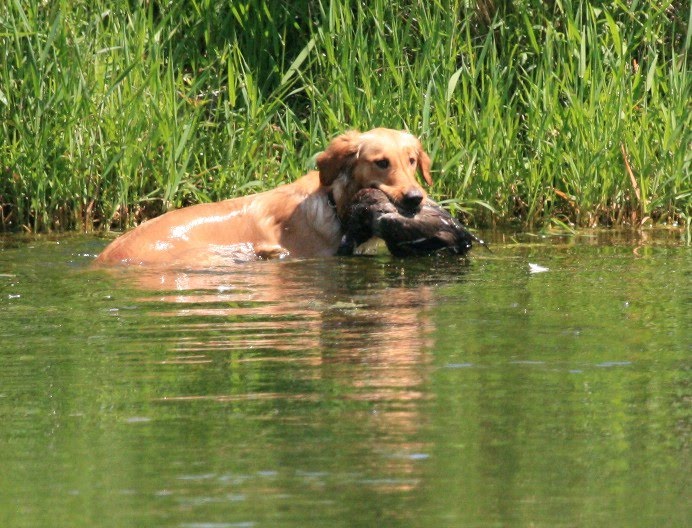
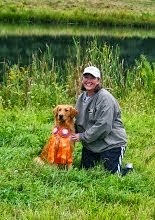
I want to thank Larry and Polly Shaffer for taking these wonderful photos. They say they aren't professionals, but these are fantastic photos! Between the Shaffers and the Ripleys I have some wonderful memories of Page's first two JH legs.

Day 1
I love the two photos of the deliver to hand. I also love the close up of her intense expression looking for the second mark. The fog gives the photos an interesting touch.

Day 2
Day 2 was bright and sunny, and decoys had sprouted everywhere! I'm quite sure Page didn't really see them; she only had eyes for her marks. I particularly like the last photo where I'm leashing Page up talking with Ed (one of the judges), and Page is ignoring us completely. I know she's thinking if she just sits there and is very patiently SURELY someone will throw another duck for her. It couldn't be over that fast! Doesn't she look pretty!


Tuesday, June 1, 2010

Page's two orange ribbon weekend

We headed to western Pennsylvania this past weekend for the Greater Pittsburgh Golden Retriever Club's spring hunt test. This is my third trip to these grounds and a test put on by this group. They are a fun group of folks, and their tests are very nice. I want to thank Steve Ripley for taking some really lovely photos of Page both days.

This was actually not Page's first Junior Hunter test. I put her in one test last fall when she was in the middle of her force fetch and she was 7 months old. She was too young and she decided she wanted to keep that nice fluffy pillow of a duck they threw for her. Now that she's 15 months old and through her basics, it was time to try again.


Saturday's test was challenging, with land marks in corn stubble with high cover. The first mark was short (approx. 50 yards) with the dogs running perpendicular to the corn rows, but there was a small rise near the line so the dogs didn't see the bird hit the ground. There were decoys on the hill just out from the line, too. The mark was hand thrown, so later dogs had a smaller arch which was hard to see with the cover.

The second land mark was longer (approx. 75 yards) with the dogs running at an angle across the corn rows and through more decoys. The dogs saw the mark land, but it was in knee-high cover. In addition to the factors making the marks challenging, the Senior Hunter test was just a few hundred yards away from us across the road. Their start time was the same as ours, and their guns were loud.

Page was catalog #8, but she ran third due to conflicts. The first two dogs had a lot of problems with the second mark, and the first dog got distracted by the senior tests' guns and left the test area. Page was definitely ready to go, and she was difficult to keep calm in the blinds. The first two dogs were black Labs. When the judge came over to ask my number, he peered over the blind to see what type of dog was coming up next. He said I'd get 15 points since I had a Golden. I told him she was the prettiest thing they had seen so far and pointed out her pink camo collar. Both judges laughed and one turned to the other and said, "This ain't her first time at the rodeo!" Page stepped on the first mark, and she only had a brief hunt for the second mark when she came up just to the left of it. Both judges were very complimentary of her land series and she got called back to water.

Page again ran third for water. She was even more excited to get out of the blinds for her second series. The water marks were straight forward. Each landed in the water right against the shore which had lots of cover. There were decoys at the water's edge, but clear paths to the birds. The edge of the pond dropped off sharply, and we were allowed to walk down to the water's edge. While it was an advantage to be close to the water to get the bird, I made the decision to stay on the top of the bank. It was the right decision for me because the grass was wet and I didn't feel like a swim that day.

Page handled the marks well, swimming in a straight line out to both of them. However, she dropped both birds at the water's edge a couple of times to shake. Then the climb up the steep bank with a heavy wet duck caused another drop on each duck. Page was quick to fetch them back up and deliver to hand, but the test environment really brings out what you have to work on!

The judges had nice things to say about Page. One said it was like she had radar for those birds, and he loved her drive. I had several exhibitors compliment her, too; it was nice that they were Lab guys. One guy stopped me and said he loved her and had never seen a Golden run like she did. He said, "She runs like a Lab!"

There were 23 dogs that started the test, 17 went to water and 16 passed. Devon got to be pick up dog for the last dog who didn't go in the water. I had the gunner assist her water blind by standing in line with the bird. She went in nicely and I whistled her once to give her an angle back when she got distracted by the gunning station. She took it nicely, and she was THRILLED to get a bird since she had sat in the van all day long.


Sunday's test was straight forward. The first land mark was about 55 yards in short cover with a hidden gunner and lots of decoys to get through. The second mark was longer through short cover and just into heavy cover, again with a hidden gunner. There were decoys but there was a nice gap through them. We had to change our line between the two marks, so it was nice practice to receive the dog at a different place. We also had to call with a duck call for our own marks. I thought these were nice junior marks sticking to the saying, "hard to get to easy to find; easy to get to hard to find."

Page lined these marks, and I was incredibly pleased with her precision marking. However, her performance in the blinds was worse (she won't relax, tries to bolt out and barks a little), and she dropped each bird once at the line before delivering to hand. The judges were complimentary, both saying she had the potential to be much more than a junior hunter.

The water marks were very nice. They were short swims (no more than 50 yards) and both splashed in open water. Page again lined her marks, but the duck was dropped a couple of times at the water's edge and on the line. As she was returning from the second mark, she had visions of swimming off into the sunset with her new best friend the duck. She paralleled the shore and I had to give her a firm "here" to get her in.

I told the judges it was clear what our homework was, and they agreed. One judge said he's seen junior dogs fail on returning that last mark because they don't want the series to end, and he was right. I knew I had to stick with her on that last duck.

On Sunday, 22 dogs started, 16 got called back to water and 15 dogs passed the test.

So Page is halfway to her Junior Hunter title, but we have some work to do. We'll be working on delivery to hand on water and steadiness in the holding blinds. Page also needs a lot more experience on ducks. She's not as comfortable carrying them as Devon always has been. Page also wants to do things at top speed, and she has to think a little more when she's carrying a duck!

Monday, May 31, 2010

Observing a VST test

Since one of my goals this year is to get Devon and Page test-ready for VST, I thought I should go watch a VST test to see what I was getting myself into. In mid-April, I went to Chicago to watch the Moraine Tracking Club's VST test at Lincolnshire. I even got to see one dog pass!

This is a wonderful tracking club, full of great and helpful people. The grounds at Lincolnshire are perfect; what a lovely office park they have to test in. Judges Ted Hoesel and Beth Walker plotted interesting tracks, and I was able to walk behind all 8 participants that day.

I think my greatest observation from the test is that thanks to training with Steve Ripley, we are on the right track (no pun intended) with our training. We're working on the things the dogs will be tested on, specifically transitions and "moment of truth" or MOT turns. I will always be grateful for the opportunity to learn from Steve and from all the tracking teams he's followed in his years of judging.

I got to see some great handling and some really bad handling at this test. It reinforced to me how important it is to trust your dog and how to be patient while the dog is working out scenting problems. Handler Allison Bently who passed that day with her GSD Meghan was the perfect example of patience and trust. After working out a MOT turn, Meghan cut the corner of the next turn when she spotted her plastic article in a parking lot. Meghan came up on the article from the south, but the leg ran east-west with the track going east to Allison's right.

After picking up the article, watering and rescenting, Meghan continued north in the direction she traveled to find the article; it was also the direction Allison was facing. However, after 15 ft. Meghan's head lifted, she circled, and she correctly identified the track to Allison's right and tracked off in that direction, 90 degrees from where Allison was facing and from the path they had taken to the article. The gallery knew this was correct, but Allison was running a blind track. When Meghan showed Allison tracking posture, Allison immediate turned and followed her dog across the parking lot and eventually through two more turns to the final article.

Following your dog in a different direction after picking up an article has got to be a hard decision. And in this case, Allison correctly chose to trust her dog and their team was rewarded with the coveted "Champion Tracker" title. Those decisions are easier to make when you know how to read your dog and you have had lots of tracking "mileage" under your belt.

Equally as educational but monumentally frustrating was following another team where the handler failed mightily in his job to read his dog. It was the team's first VST test, and this amazing Golden Retriever made the first leg of this track look easy. I learned from club members and seasoned trackers, that the leg full of transitions in front of a large building with the wind coming off the pond was extremely difficult. After turning at the side of the building, the dog didn't hesitate to track straight into the middle of a parking lot.

Even to me, it was clear when the dog indicated loss of scent and wanted to make a right MOT turn. The dog indicated this turn several times and the gallery became hopeful we'd see another pass that day. However, our hopes were dashed as the handler forced the dog forward ignoring more than a dozen indications of a right hard surface turn.

The ever patient judges allowed this team to work left and eventually the dog brought the handler back to the very same spot and again indicated the right MOT turn. This time the handler took it and our hopes soared. However, when dog and handler reached a grassy island and the dog indicated a left turn on the island, the handler again ignored his dog. Eventually the confused handler circled back around to the right and ended up on the previous leg (even walking right past the judges going in the wrong direction) and again pushed his dog past the MOT turn the dog had worked so hard to accomplish. That is when they heard the whistle.

As a member of the gallery, I got to witness first hand how frustrating it must be to be a VST judge. After seeing more than a dozen indications of that turn from the dog, I lost count how many times that dog told his handler where the track went, only to have the handler think he knew better. No matter how much you think you know, you must over-ride your brain and follow your dog. The dog has the nose and knows where the track is. Your job is to recognize when the dog is on the track and when he/she isn't.

Finally, I got to see several MOT turns on actual test tracks. I now have a better understanding of these turns and how they can be used. According to the AKC's Tracking Regulations, a MOT is defined as:
At least one (1) moment of truth 90-degree turn will be in an area devoid of
vegetation and will be plotted to allow at least thirty (30) yards before crossing
or returning to a vegetated surface.
I had always envisioned MOTs as turns in the middle of a parking lot or non-vegetated area and no vegetation within 30 yards in any direction. While that is an example of an MOT, I also got to see other examples which were turns that were devoid of vegetation, at least 30 yards from vegetation in many directions and could not be successfully accomplished by fringing the scent on vegetation.

Here is an example of two MOTs. Turn 2 is what I would typically think of as an MOT. However, Turn 1 is also an MOT. There is an island close to one leg before the turn; but the turn could not be successfully done with the dog working any vegetation and the track did not cross vegetation for more than 30 yards. Seeing turns like this gives me even more ideas for working MOT as we train.

Our trip to Lincolnshire was educational and worth the time we took. It encouraged me that our training is going in the right direction. And it gave me real life examples of how important it is to read your dog and trust your dog while tracking.